On-Grid vs Off-Grid Solar in India: Which Is Right for You in 2026?
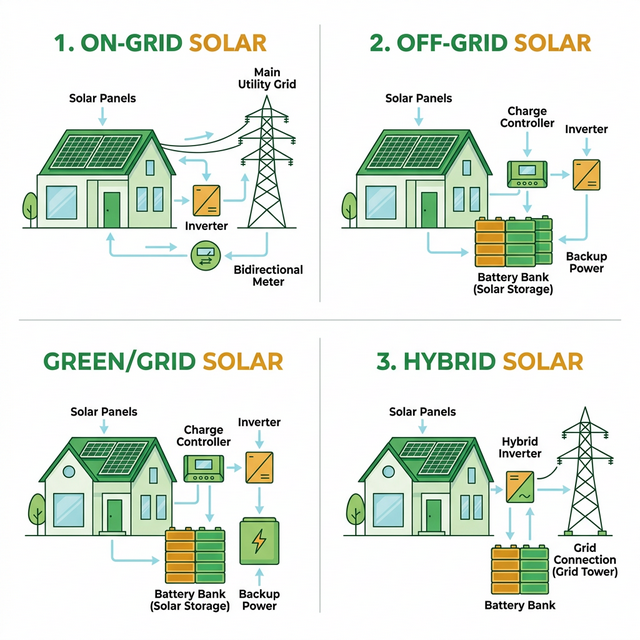
People shopping for solar in India usually hear three terms very early: on-grid, off-grid, and hybrid. These are often explained poorly. One salesperson says off-grid gives “total freedom.” Another says on-grid is always best. The right answer depends less on fashion and more on your electricity reliability, your budget, and whether your home or business can tolerate outages.
If you understand one core difference, the rest becomes much easier. On-grid solar uses the electricity grid as your backup. Off-grid solar uses batteries as your backup. Hybrid combines both. Everything else, from cost to subsidy to user experience, flows from that choice.
The key difference in one sentence
On-grid systems depend on the grid being available when solar production is low. Off-grid systems depend on batteries being available when solar production is low. A hybrid system can do both. That single distinction affects your cost, maintenance, subsidy position, and power-cut experience.
On-grid solar: pros, cons, who it's for
On-grid solar is the default recommendation for most urban Indian homes. It is the most cost-effective format because it avoids the large battery expense. During the day, your panels generate electricity for your home. If you produce more than you use, the extra can be exported through net metering, subject to local rules. At night or during low generation, you pull power from the grid as usual.
The biggest advantages are price and payback. On-grid systems are generally eligible for the most straightforward subsidy structure, and they provide the strongest return for families trying to reduce monthly bills. The main limitation is also important: standard on-grid systems typically shut down during a power cut for safety reasons, even if the sun is shining. So if your area has frequent outages and uninterrupted power is essential, on-grid alone may feel incomplete.
For a city home with decent DISCOM reliability, predictable billing, and no special backup requirement, on-grid remains the sensible choice. If you want to estimate the correct size first, start with the solar calculator.
Off-grid solar: pros, cons, who it's for
Off-grid solar uses batteries to store energy for later use. This gives true independence from the grid or at least deep reduction in grid dependence. That is why off-grid setups make sense in farmhouses, rural sites, remote properties, and parts of India where outages are not occasional annoyances but a daily operating reality.
The tradeoff is cost. Batteries can add roughly 30 to 40 percent or more to the project cost depending on chemistry, backup requirement, and discharge design. Battery systems also need more careful maintenance logic, temperature awareness, and replacement planning over the long term. You do not get the simplicity of exporting to the grid in the same way an on-grid net-metered customer can.
Another practical difference is system discipline. Off-grid users need to think about load priority in a way on-grid users often do not. If a property is trying to run pumps, multiple air conditioners, kitchen appliances, and lighting from stored energy, battery sizing becomes critical. That means off-grid is rarely a “cheap alternative to the grid.” It is a deliberate energy design choice for places where reliability or independence matters more than the shortest payback.
Off-grid is worth considering when the grid is weak, absent, or so unreliable that business continuity or basic household functioning becomes difficult. It is also practical where diesel generator dependence is expensive and unpleasant. In those cases, the higher cost buys you resilience, not just energy savings.
Hybrid solar: premium option explained
Hybrid systems combine solar, grid connectivity, and battery backup. They are effectively the “best of both worlds” option, but also the most expensive. A good hybrid setup can keep selected loads running during outages while still allowing solar self-consumption and grid interaction. For homes with medical equipment, clinics, premium residences, or businesses that cannot afford dark periods, hybrid can be the most rational choice.
What many buyers miss is that hybrid is not automatically better for everyone. It is better only if the extra reliability is valuable enough to justify the additional capital cost. If your area has stable power and your main goal is bill reduction, that extra spend may not be necessary.
Three questions to decide which is right for you
First, how reliable is your grid? If outages are rare and short, on-grid is usually enough. If they are frequent and disruptive, hybrid or off-grid deserves serious consideration. Second, what is your budget? A customer who wants the shortest payback period should usually stay on-grid. Third, do you have critical loads that must run 24/7, such as clinic equipment, security systems, networking gear, refrigerators with sensitive stock, or home medical devices? If yes, battery-backed design becomes much more attractive.
These three questions are more useful than generic marketing labels because they tie the system choice to lived reality. Solar must match the job it is meant to do.
A fourth, quieter question is whether your consumption happens in the daytime or at night. Homes where people are away all day and return late evening may still save well with on-grid solar, but the role of export rules becomes more important. Businesses with strong daytime loads usually benefit very naturally from on-grid systems because they consume power when the sun is strongest. Load timing is often the missing piece in first-time solar decisions.
Price comparison table (3kW example)
| System type | Typical price | What you get |
|---|---|---|
| On-grid | ₹1,32,000 after subsidy | Best ROI, grid-connected, no battery backup during outage |
| Off-grid | ₹1,80,000–₹2,20,000 | Battery backup, higher independence, no simple net metering benefit |
| Hybrid | ₹2,50,000–₹3,00,000 | Grid plus battery backup, premium performance and flexibility |
For most urban households, the honest answer is still on-grid. For properties that suffer 6+ hours of daily power cuts, off-grid or hybrid may be the wiser investment despite the higher upfront cost. If you want a recommendation tied to your bills and expected loads, book a consultation through AdiSolar rather than choosing a system type in the abstract.
That consultation matters because the best answer is sometimes mixed. A family may choose an on-grid system for savings and pair it with a smaller, separate inverter backup for critical lights and fans. Another customer may start on-grid and plan a later battery upgrade. The point is to solve the actual problem, not to buy the most impressive label.
Frequently asked questions
Does on-grid solar work during a power cut?
Usually no. Standard on-grid systems shut down during outages to protect utility workers and comply with safety requirements.
Is off-grid solar always better for villages?
Not always. If the local grid is improving and net metering is practical, on-grid or hybrid may still be the better long-term value. The choice depends on actual reliability and economics.
Can I start on-grid and add batteries later?
Sometimes yes, especially if the system is designed with future upgrade paths in mind. That is one reason choosing the right inverter strategy at the beginning matters.
Author
Written by Amit Kulkarni, AdiSolar
Amit Kulkarni works with the AdiSolar team to turn subsidy rules, pricing, and rooftop design decisions into practical guidance for Indian homes and businesses.
Ready to go solar? Book your free site visit
Get a rooftop assessment, system recommendation, and honest pricing based on your actual roof and monthly consumption.
Book your free site visitContinue Reading
Related posts
Solar Panel Cost in India 2026: What You'll Actually Pay (After Subsidy)
A 3 kW residential system costs ₹1,20,000–₹1,80,000 after government subsidy. Here's how the numbers break down.
Read this nextPM Surya Ghar Muft Bijli Yojana: Complete Application Guide for 2026
Up to ₹78,000 in central subsidy is available to Indian homeowners. Here's exactly how to apply and what to expect.
Read this nextHow Many Solar Panels Do You Need for Your Home in India? (Simple Formula)
The number of panels depends on your monthly units and roof space. Here is the exact calculation with worked examples.
Read this next